what change would be required in the chart to reflect the reality of the electoral process today
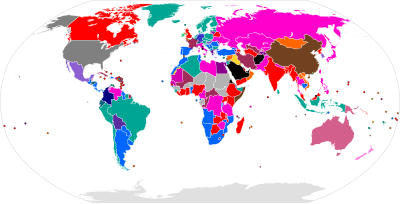
An electoral system or voting system is a set of rules that determine how elections and referendums are conducted and how their results are adamant. Political balloter systems are organized by governments, while non-political elections may take place in concern, non-profit organisations and informal organisations. These rules govern all aspects of the voting process: when elections occur, who is immune to vote, who can stand every bit a candidate, how ballots are marked and cast, how the ballots are counted, how votes translate into the election outcome, limits on campaign spending, and other factors that tin can affect the consequence. Political electoral systems are defined by constitutions and electoral laws, are typically conducted by election commissions, and can utilize multiple types of elections for different offices.
Some electoral systems elect a single winner to a unique position, such equally prime government minister, president or governor, while others elect multiple winners, such equally members of parliament or boards of directors. When electing a legislature, voters may exist divided into constituencies with ane or more representatives, and may vote straight for individual candidates or for a list of candidates put frontwards past a political party or alliance. There are many variations in electoral systems, with the nigh common systems beingness outset-past-the-post voting, block voting, the ii-round (runoff) organisation, proportional representation and ranked voting. Some electoral systems, such equally mixed systems, attempt to combine the benefits of non-proportional and proportional systems.
The study of formally defined electoral methods is called social option theory or voting theory, and this study tin can take place inside the field of political science, economics, or mathematics, and specifically within the subfields of game theory and mechanism design. Impossibility proofs such as Arrow's impossibility theorem demonstrate that when voters have three or more alternatives, no preferential voting system can guarantee the race betwixt ii candidates remains unaffected when an irrelevant candidate participates or drops out of the election.
Types of balloter systems [edit]
Plurality systems [edit]
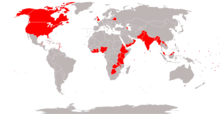
Countries using first-by-the-post for legislatures.
Plurality voting is a system in which the candidate(s) with the highest number of votes wins, with no requirement to go a majority of votes. In cases where there is a single position to be filled, information technology is known as offset-by-the-post; this is the second well-nigh common electoral system for national legislatures, with 58 countries using information technology to elect their legislatures,[1] the vast majority of which are current or one-time British or American colonies or territories. Information technology is besides the 2d most mutual system used for presidential elections, existence used in xix countries.[i]
In cases where there are multiple positions to exist filled, nearly commonly in cases of multi-fellow member constituencies, plurality voting is referred to equally cake voting, multiple non-transferable vote or plurality-at-big.[1] This takes 2 chief forms: in i form voters have every bit many votes as at that place are seats and can vote for any candidate, regardless of party – this is used in eight countries.[1] In that location are variations on this system such as limited voting, where voters are given fewer votes than there are seats to exist filled (Gibraltar is the just territory where this system is in employ)[1] and unmarried not-transferable vote (SNTV), in which voters can vote for only one candidate in a multi-member constituency, with the candidates receiving the near votes declared the winners; this system is used in Transitional islamic state of afghanistan, Kuwait, the Pitcairn Islands and Vanuatu.[1] In the other main form of cake voting, likewise known as political party block voting, voters tin only vote for the multiple candidates of a unmarried party. This is used in 5 countries as part of mixed systems.[ane]
The Dowdall organisation, a multi-member constituency variation on the Borda count, is used in Nauru for parliamentary elections and sees voters rank the candidates depending on how many seats there are in their constituency. Beginning preference votes are counted as whole numbers; the 2nd preference votes divided by two, third preferences by three; this continues to the lowest possible ranking.[2] The totals achieved past each candidate determine the winners.[3]
Majoritarian systems [edit]
Majoritarian voting is a arrangement in which candidates must receive a majority of votes to be elected, either in a runoff election or last round of voting (although in some cases only a plurality is required in the last round of voting if no candidate can achieve a majority). There are 2 main forms of majoritarian systems, one conducted in a single election using ranked voting and the other using multiple elections, to successively narrow the field of candidates. Both are primarily used for single-member constituencies.
Majoritarian voting can be achieved in a single ballot using instant-runoff voting (IRV), whereby voters rank candidates in order of preference; this system is used for parliamentary elections in Commonwealth of australia and Papua New Guinea. If no candidate receives a bulk of the vote in the showtime round, the second preferences of the lowest-ranked candidate are then added to the totals. This is repeated until a candidate achieves over 50% of the number of valid votes. If not all voters apply all their preference votes, then the count may go along until two candidates remain, at which point the winner is the 1 with the most votes. A modified form of IRV is the contingent vote where voters practise not rank all candidates, but have a express number of preference votes. If no candidate has a majority in the starting time circular, all candidates are excluded except the elevation two, with the highest remaining preference votes from the votes for the excluded candidates then added to the totals to determine the winner. This system is used in Sri Lankan presidential elections, with voters allowed to requite iii preferences.[iv]
The other master class of majoritarian system is the ii-round organization, which is the near common arrangement used for presidential elections around the world, being used in 88 countries. It is also used in 20 countries for electing the legislature.[1] If no candidate achieves a majority of votes in the get-go round of voting, a 2d round is held to determine the winner. In nigh cases the second round is limited to the height 2 candidates from the first circular, although in some elections more than ii candidates may choose to competition the second round; in these cases the second round is decided by plurality voting. Some countries apply a modified course of the two-round system, such as Ecuador where a candidate in the presidential election is alleged the winner if they receive forty% of the vote and are 10% ahead of their nearest rival,[5] or Argentina (45% plus x% alee), where the organization is known as ballotage.
An exhaustive ballot is not limited to 2 rounds, only sees the last-placed candidate eliminated in each circular of voting. Due to the potentially large number of rounds, this system is not used in any major pop elections, but is used to elect the Speakers of parliament in several countries and members of the Swiss Federal Council. In some formats in that location may be multiple rounds held without any candidates being eliminated until a candidate achieves a bulk, a system used in the United states Electoral College.
Proportional systems [edit]
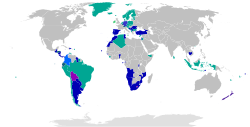
Countries past type of proportional system
Proportional representation is the nigh widely used electoral organization for national legislatures, with the parliaments of over 80 countries elected by various forms of the system.
Party-listing proportional representation is the single most common balloter organization and is used by 80 countries, and involves voters voting for a list of candidates proposed by a party. In closed list systems voters practice not have any influence over the candidates put forward by the political party, just in open list systems voters are able to both vote for the party list and influence the order in which candidates will be assigned seats. In some countries, notably Israel and holland, elections are carried out using 'pure' proportional representation, with the votes tallied on a national level before assigning seats to parties. However, in most cases several multi-fellow member constituencies are used rather than a single nationwide constituency, giving an element of geographical representation; but this can consequence in the distribution of seats non reflecting the national vote totals. As a result, some countries have leveling seats to award to parties whose seat totals are lower than their proportion of the national vote.
In addition to the balloter threshold (the minimum percentage of the vote that a party must obtain to win seats), there are several different means to allocate seats in proportional systems. There are two main types of systems: highest average and largest residuum. Highest average systems involve dividing the votes received by each political party by a series of divisors, producing figures that determine seat allocation; for example the D'Hondt method (of which there are variants including Hagenbach-Bischoff) and the Webster/Sainte-Laguë method. Under largest remainder systems, parties' vote shares are divided by the quota (obtained by dividing the total number of votes past the number of seats available). This commonly leaves some seats unallocated, which are awarded to parties based on the largest fractions of seats that they have remaining. Examples of largest remainder systems include the Hare quota, Droop quota, the Imperiali quota and the Hagenbach-Bischoff quota.
Single transferable vote (STV) is another grade of proportional representation; in STV, voters rank candidates in a multi-member constituency rather than voting for a party listing; information technology is used in Republic of malta and the Republic of Republic of ireland. To be elected, candidates must pass a quota (the Droop quota being the almost common). Candidates that laissez passer the quota on the outset count are elected. Votes are then reallocated from the least successful candidates, too as surplus votes from successful candidates, until all seats have been filled by candidates who have passed the quota.[3]
Mixed systems [edit]
In several countries, mixed systems are used to elect the legislature. These include parallel voting (besides known as mixed-member majoritarian) and mixed-fellow member proportional representation.
In not-compensatory, parallel voting systems, which are used in 20 countries,[1] there are two methods by which members of a legislature are elected; part of the membership is elected by a plurality or majority vote in single-member constituencies and the other part past proportional representation. The results of the constituency vote have no event on the consequence of the proportional vote.[3]
In compensatory mixed-member representation the results of the proportional vote are adjusted to remainder the seats won in the constituency vote. In mixed-member proportional systems, in use in eight countries, there is enough compensation in society to ensure that parties have a number of seats proportional to their vote share.[1]
Other systems may exist comparatively compensatory, and this may issue in overhang seats, where parties win more than seats in the constituency organization than they would be entitled to based on their vote share. Variations of this include the Additional Fellow member System, and Culling Vote Plus, in which voters cast votes for both unmarried-member constituencies and multi-member constituencies; the allocation of seats in the multi-fellow member constituencies is adapted to achieve an overall seat full proportional to parties' vote share past taking into account the number of seats won by parties in the single-fellow member constituencies.
Mixed unmarried vote systems are also compensatory, however they normally apply a vote transfer mechanism different the seat linkage (top-up) method of MMP and may or may not exist able to achieve proportional representation. An unusual form of mixed-member compensatory representation using negative vote transfer, Scorporo, was used in Italy from 1993 until 2006.
Additional features [edit]
Some balloter systems feature a bulk bonus system to either ensure 1 party or coalition gains a majority in the legislature, or to give the political party receiving the most votes a articulate advantage in terms of the number of seats. In Greece the political party receiving the almost votes is given an additional l seats,[6] San Marino has a modified two-circular system, which sees a second circular of voting featuring the peak two parties or coalitions if at that place is no majority in the showtime circular. The winner of the second round is guaranteed 35 seats in the 60-seat Grand and General Council.[7]
In Uruguay, the President and members of the General Assembly are elected by on a single election, known as the double simultaneous vote. Voters bandage a single vote, voting for the presidential, Senatorial and Chamber of Deputies candidates of that political party. This system was likewise previously used in Bolivia and the Dominican Republic.
Master elections [edit]
Primary elections are a feature of some electoral systems, either as a formal function of the electoral system or informally by choice of individual political parties as a method of selecting candidates, equally is the case in Italy. Principal elections limit the chance of vote splitting by ensuring a single party candidate. In Argentina they are a formal part of the electoral system and take identify two months earlier the main elections; any party receiving less than i.5% of the vote is not permitted to competition the main elections. In the Us, there are both partisan and non-partisan chief elections.
Indirect elections [edit]
Some elections feature an indirect electoral system, whereby in that location is either no pop vote, or the pop vote is only ane stage of the election; in these systems the final vote is usually taken by an electoral higher. In several countries, such as Mauritius or Trinidad and Tobago, the post of President is elected by the legislature. In others like India, the vote is taken by an electoral college consisting of the national legislature and state legislatures. In the United States, the president is indirectly elected using a ii-phase process; a popular vote in each country elects members to the electoral higher that in turn elects the President. This can effect in a state of affairs where a candidate who receives the most votes nationwide does non win the electoral higher vote, as most recently happened in 2000 and 2016.
Systems used exterior politics [edit]
In addition to the diverse electoral systems in utilise in the political sphere, at that place are numerous others, some of which are proposals and some of which accept been adopted for usage in business organisation (such as electing corporate lath members) or for organisations but not for public elections.
Ranked systems include Bucklin voting, the various Condorcet methods (Copeland'due south, Dodgson's, Kemeny-Young, Maximal lotteries, Minimax, Nanson'due south, Ranked pairs, Schulze), the Coombs' method and positional voting. There are also several variants of single transferable vote, including CPO-STV, Schulze STV and the Wright arrangement. Dual-member proportional representation is a proposed system with two candidates elected in each constituency, one with the well-nigh votes and ane to ensure proportionality of the combined results. Biproportional apportionment is a organization whereby the total number of votes is used to summate the number of seats each party is due, followed by a calculation of the constituencies in which the seats should be awarded in lodge to achieve the total due to them.
Cardinal electoral systems allow voters to evaluate candidates independently. The complexity ranges from approval voting where voters merely state whether they approve of a candidate or not to range voting, where a candidate is scored from a set range of numbers. Other key systems include proportional approval voting, sequential proportional approving voting, satisfaction approval voting, highest median rules (including the majority judgment), and the D21 – Janeček method where voters tin can bandage positive and negative votes.
Historically, weighted voting systems were used in some countries. These allocated a greater weight to the votes of some voters than others, either indirectly past allocating more than seats to sure groups (such as the Prussian three-form franchise), or by weighting the results of the vote. The latter system was used in colonial Rhodesia for the 1962 and 1965 elections. The elections featured two voter rolls (the 'A' gyre being largely European and the 'B' whorl largely African); the seats of the House Associates were divided into 50 constituency seats and 15 commune seats. Although all voters could vote for both types of seats, 'A' whorl votes were given greater weight for the constituency seats and 'B' coil votes greater weight for the commune seats. Weighted systems are still used in corporate elections, with votes weighted to reflect stock buying.
Rules and regulations [edit]
In addition to the specific method of electing candidates, electoral systems are also characterised by their wider rules and regulations, which are usually set out in a country'due south constitution or electoral law. Participatory rules determine candidate nomination and voter registration, in addition to the location of polling places and the availability of online voting, postal voting, and absentee voting. Other regulations include the selection of voting devices such as paper ballots, motorcar voting or open up ballot systems, and consequently the type of vote counting systems, verification and auditing used.

Compulsory voting, enforced.
Compulsory voting, not enforced.
Compulsory voting, enforced (only men).
Compulsory voting, not enforced (simply men).
Historical: the country had compulsory voting in the past.
Balloter rules place limits on suffrage and candidacy. Near countries'south electorates are characterised by universal suffrage, just in that location are differences on the age at which people are immune to vote, with the youngest being 16 and the oldest 21 (although voters must be 25 to vote in Senate elections in Italia). People may be disenfranchised for a range of reasons, such as being a serving prisoner, being declared bankrupt, having committed certain crimes or being a serving member of the armed services. Similar limits are placed on candidacy (also known as passive suffrage), and in many cases the age limit for candidates is higher than the voting age. A total of 21 countries have compulsory voting, although in some there is an upper historic period limit on enforcement of the law.[viii] Many countries too have the none of the above option on their ballot papers.
In systems that use constituencies, apportionment or districting defines the surface area covered by each constituency. Where constituency boundaries are fatigued has a strong influence on the probable outcome of elections in the constituency due to the geographic distribution of voters. Political parties may seek to gain an reward during redistricting past ensuring their voter base has a majority in as many constituencies as possible, a process known as gerrymandering. Historically rotten and pocket boroughs, constituencies with unusually small populations, were used by wealthy families to gain parliamentary representation.
Some countries have minimum turnout requirements for elections to be valid. In Serbia this rule caused multiple re-runs of presidential elections, with the 1997 election re-run once and the 2002 elections re-run iii times due insufficient turnout in the first, second and third attempts to run the ballot. The turnout requirement was scrapped prior to the fourth vote in 2004.[9] Similar bug in Belarus led to the 1995 parliamentary elections going to a quaternary round of voting before enough parliamentarians were elected to make a quorum.[10]
Reserved seats are used in many countries to ensure representation for ethnic minorities, women, young people or the disabled. These seats are separate from general seats, and may be elected separately (such as in Morocco where a split ballot is used to elect the 60 seats reserved for women and 30 seats reserved for young people in the Firm of Representatives), or be allocated to parties based on the results of the election; in Jordan the reserved seats for women are given to the female candidates who failed to win constituency seats only with the highest number of votes, whilst in Kenya the Senate seats reserved for women, young people and the disabled are allocated to parties based on how many seats they won in the general vote. Some countries attain minority representation by other means, including requirements for a certain proportion of candidates to be women, or by exempting minority parties from the electoral threshold, as is done in Poland,[11] Romania and Serbia.[12]
History [edit]
Pre-democratic [edit]
In aboriginal Greece and Italian republic, the institution of suffrage already existed in a rudimentary form at the outset of the historical period. In the early monarchies information technology was customary for the male monarch to invite pronouncements of his people on matters in which it was prudent to secure its assent beforehand. In these assemblies the people recorded their opinion by clamouring (a method which survived in Sparta as late as the 4th century BCE), or past the clashing of spears on shields.[13]
Early democracy [edit]
Voting has been used as a feature of democracy since the 6th century BC, when democracy was introduced by the Athenian democracy. However, in Athenian democracy, voting was seen as the to the lowest degree democratic among methods used for selecting public officials, and was piddling used, because elections were believed to inherently favor the wealthy and well-known over average citizens. Viewed equally more democratic were assemblies open to all citizens, and pick by lot, besides every bit rotation of office.
Generally, the taking of votes was effected in the class of a poll. The practice of the Athenians, which is shown by inscriptions to have been widely followed in the other states of Greece, was to hold a show of easily, except on questions affecting the status of individuals: these latter, which included all lawsuits and proposals of ostracism, in which voters chose the citizen they most wanted to exile for ten years, were adamant by secret election (ane of the earliest recorded elections in Athens was a plurality vote that it was undesirable to win, namely an ostracism vote). At Rome the method which prevailed upwards to the second century BCE was that of segmentation ( discessio ). Only the organization became discipline to intimidation and corruption. Hence a series of laws enacted between 139 and 107 BCE prescribed the use of the election ( tabella ), a slip of wood coated with wax, for all business done in the assemblies of the people. For the purpose of conveying resolutions a unproblematic bulk of votes was accounted sufficient. Every bit a general rule equal value was made to attach to each vote; but in the pop assemblies at Rome a system of voting by groups was in force until the eye of the 3rd century BCE by which the richer classes secured a decisive preponderance.[13]
Most elections in the early history of democracy were held using plurality voting or some variant, but as an exception, the country of Venice in the 13th century adopted approval voting to elect their Corking Council.[14] The Venetians' method for electing the Doge was a peculiarly convoluted process, consisting of five rounds of drawing lots (sortition) and five rounds of approval voting. By drawing lots, a body of 30 electors was chosen, which was further reduced to nine electors by drawing lots again. An electoral college of ix members elected 40 people by approval voting; those xl were reduced to grade a second balloter higher of 12 members by cartoon lots once more. The second electoral college elected 25 people past approval voting, which were reduced to form a third balloter college of nine members by drawing lots. The third electoral college elected 45 people, which were reduced to form a fourth electoral college of 11 by cartoon lots. They in turn elected a concluding electoral body of 41 members, who ultimately elected the Doge. Despite its complexity, the method had certain desirable backdrop such as existence difficult to game and ensuring that the winner reflected the opinions of both majority and minority factions.[xv] This process, with slight modifications, was central to the politics of the Republic of Venice throughout its remarkable lifespan of over 500 years, from 1268 to 1797.
Development of new systems [edit]
Jean-Charles de Borda proposed the Borda count in 1770 as a method for electing members to the French Academy of Sciences. His method was opposed by the Marquis de Condorcet, who proposed instead the method of pairwise comparison that he had devised. Implementations of this method are known as Condorcet methods. He also wrote virtually the Condorcet paradox, which he called the intransitivity of majority preferences. Yet, recent research has shown that the philosopher Ramon Llull devised both the Borda count and a pairwise method that satisfied the Condorcet criterion in the 13th century. The manuscripts in which he described these methods had been lost to history until they were rediscovered in 2001.[16]
Afterwards in the 18th century, circulation methods came to prominence due to the United States Constitution, which mandated that seats in the United states Firm of Representatives had to exist allocated among u.s.a. proportionally to their population, simply did not specify how to do so.[17] A variety of methods were proposed past statesmen such as Alexander Hamilton, Thomas Jefferson, and Daniel Webster. Some of the circulation methods devised in the United states were in a sense rediscovered in Europe in the 19th century, every bit seat resource allotment methods for the newly proposed method of party-list proportional representation. The upshot is that many apportionment methods have 2 names; Jefferson'south method is equivalent to the D'Hondt method, as is Webster's method to the Sainte-Laguë method, while Hamilton's method is identical to the Hare largest balance method.[17]
The single transferable vote (STV) method was devised by Carl Andræ in Denmark in 1855 and in the United kingdom of great britain and northern ireland by Thomas Hare in 1857. STV elections were first held in Denmark in 1856, and in Tasmania in 1896 later its use was promoted past Andrew Inglis Clark. Party-list proportional representation began to be used to elect European legislatures in the early 20th century, with Belgium the first to implement information technology for its 1900 general elections. Since then, proportional and semi-proportional methods have come to be used in almost all democratic countries, with most exceptions beingness former British and French colonies.[18]
Unmarried-winner revival [edit]
Perhaps influenced by the rapid development of multiple-winner electoral systems, theorists began to publish new findings virtually single-winner methods in the tardily 19th century. This began effectually 1870, when William Robert Ware proposed applying STV to single-winner elections, yielding instant-runoff voting (IRV).[xix] Soon, mathematicians began to revisit Condorcet'due south ideas and invent new methods for Condorcet completion; Edward J. Nanson combined the newly described instant runoff voting with the Borda count to yield a new Condorcet method called Nanson'south method. Charles Dodgson, meliorate known as Lewis Carroll, proposed the straightforward Condorcet method known every bit Dodgson's method. He too proposed a proportional representation organization based on multi-member districts, quotas as minimum requirements to take seats, and votes transferable by candidates through proxy voting.[20]
Ranked voting electoral systems eventually gathered enough support to be adopted for utilize in government elections. In Australia, IRV was first adopted in 1893, and continues to be used forth with STV today. In the U.s. in the early-20th-century progressive era, some municipalities began to use Bucklin voting, although this is no longer used in whatever government elections, and has fifty-fifty been declared unconstitutional in Minnesota.[21]
Recent developments [edit]
The use of game theory to analyze balloter systems led to discoveries about the effects of certain methods. Earlier developments such every bit Arrow's impossibility theorem had already shown the issues with Ranked voting systems. Research led Steven Brams and Peter Fishburn to formally ascertain and promote the use of approval voting in 1977.[22] Political scientists of the 20th century published many studies on the effects that the electoral systems have on voters' choices and political parties,[23] [24] [25] and on political stability.[26] [27] A few scholars also studied which effects caused a nation to switch to a particular electoral system.[28] [29] [30] [31] [32]
The report of electoral systems influenced a new push for balloter reform beginning around the 1990s, when proposals were made to replace plurality voting in governmental elections with other methods. New Zealand adopted mixed-fellow member proportional representation for the 1993 general elections and STV for some local elections in 2004. Later plurality voting was a key cistron in the contested results of the 2000 presidential elections in the United States, various municipalities in the The states began to adopt instant-runoff voting, although some of them subsequently returned to their prior method. Nevertheless, attempts at introducing more than proportional systems were not ever successful; in Canada there were two referendums in British Columbia in 2005 and 2009 on adopting an STV method, both of which failed. In the United Kingdom, a 2011 referendum on adopting IRV saw the proposal rejected.
In other countries in that location were calls for the restoration of plurality or majoritarian systems or their establishment where they accept never been used; a referendum was held in Ecuador in 1994 on the adoption the two round system, but the idea was rejected. In Romania a proposal to switch to a two-circular organization for parliamentary elections failed simply because voter turnout in the referendum was too low. Attempts to reintroduce single-member constituencies in Poland (2015) and 2-round arrangement in Bulgaria (2016) via referendums both likewise failed due to low turnout.
Comparison of electoral systems [edit]
Electoral systems tin can be compared by unlike ways. Attitudes towards systems are highly influenced by the systems' impact on groups that one supports or opposes, which can make the objective comparison of voting systems difficult. In that location are several ways to address this problem:
1 approach is to define criteria mathematically, such that any electoral organization either passes or fails. This gives perfectly objective results, but their practical relevance is still arguable.
Some other approach is to define platonic criteria that no balloter system passes perfectly, and then see how often or how close to passing diverse methods are over a big sample of simulated elections. This gives results which are practically relevant, but the method of generating the sample of simulated elections can still be arguably biased.
A last approach is to create imprecisely divers criteria, and then assign a neutral trunk to evaluate each method according to these criteria. This approach tin can look at aspects of electoral systems which the other two approaches miss, but both the definitions of these criteria and the evaluations of the methods are still inevitably subjective.
Arrow's theorem and the Gibbard–Satterthwaite theorem show that no system using ranked voting can meet all such criteria simultaneously, while Gibbard'due south theorem proves the aforementioned for all deterministic voting methods. Instead of debating the importance of different criteria, another method is to simulate many elections with different balloter systems, and estimate the typical overall happiness of the population with the results,[33] [34] their vulnerability to strategic voting, their likelihood of electing the candidate closest to the average voter, etc.
Co-ordinate to a 2006 survey of electoral system experts, their preferred balloter systems were in lodge of preference:[35]
- Mixed member proportional
- Single transferable vote
- Open list proportional
- Alternative vote
- Closed list proportional
- Single member plurality
- Runoffs
- Mixed member majoritarian
- Single non-transferable vote
See as well [edit]
- Comparison of electoral systems
- Ballot
- Listing of electoral systems by country
- Matrix vote
- Spoiler effect
- Psephology
References [edit]
- ^ a b c d e f thou h i j Tabular array of Electoral Systems Worldwide Archived 2017-05-23 at the Wayback Automobile Idea
- ^ Republic of nauru Parliament: Electoral system IPU
- ^ a b c Glossary of Terms Archived 2017-06-11 at the Wayback Machine Idea
- ^ Sri Lanka: Election for President IFES
- ^ Ecuador: Election for President Archived 2016-12-24 at the Wayback Machine IFES
- ^ Hellenic Parliament: Balloter arrangement IPU
- ^ Consiglio grande e generale: Balloter organization IPU
- ^ Suffrage Archived 2008-01-09 at the Wayback Auto CIA Earth Factbook
- ^ Pro-Western Candidate Wins Serbian Presidential Poll Deutsche Welle, 28 June 2004
- ^ Elections held in 1995 IPU
- ^ Sejm: Electoral system IPU
- ^ Narodna skupstina: Electoral organisation IPU
- ^ a b I or more of the preceding sentences incorporates text from a publication now in the public domain:Chisholm, Hugh, ed. (1911). "Vote and Voting". Encyclopædia Britannica. Vol. 28 (11th ed.). Cambridge University Printing. p. 216.
- ^ J.J. O'Connor & E. F. Robertson The history of voting MacTutor History of Mathematics annal
- ^ Miranda Mowbray & Dieter Gollmann (2007) Electing the Doge of Venice: Analysis of a 13th Century Protocol
- ^ Chiliad. Hägele & F. Pukelsheim (2001) "Llull's writings on electoral systems", Studia Lulliana Vol. 3, pp. 3–38
- ^ a b Circulation: Introduction American Mathematical Society
- ^ Proportional Voting Effectually the World FairVote
- ^ The History of IRV FairVote
- ^ Charles Dodgson (1884) Principles of Parliamentary Representation
- ^ Tony Anderson Solgård & Paul Landskroener (2002) "Municipal Voting System Reform: Overcoming the Legal Obstacles", Bench & Bar of Minnesota, Vol. 59, no. nine
- ^ Poundstone, William (2008) Gaming the Vote: Why Elections Aren't Off-white (and What We Tin Do Well-nigh It), Hill and Immature, p. 198
- ^ Duverger, Maurice (1954) Political Parties, Wiley ISBN 0-416-68320-7
- ^ Douglas W. Rae (1971) The Political Consequences of Electoral Laws, Yale Academy Printing ISBN 0-300-01517-eight
- ^ Rein Taagapera & Matthew South. Shugart (1989) Seats and Votes: The Effects and Determinants of Balloter Systems, Yale University Press
- ^ Ferdinand A. Hermens (1941) Democracy or Chaos? A Study of Proportional Representation, University of Notre Dame.
- ^ Arend Lijphart (1994) Electoral Systems and Party Systems: A Study of 20-Seven Democracies, 1945–1990 Oxford University Press ISBN 0-xix-828054-8
- ^ Arend Lijphart (1985) "The Field of Balloter Systems Inquiry: A Critical Survey" Electoral Studies, Vol. 4
- ^ Arend Lijphart (1992) "Democratization and Constitutional Choices in Czecho-Slovakia, Hungary and Poland, 1989–1991" Journal of Theoretical Politics Vol. 4 (two), pp. 207–23
- ^ Stein Rokkan (1970) Citizens, Elections, Parties: Approaches to the Comparative Study of the Process of Development, Universitetsforlaget
- ^ Ronald Rogowski (1987) "Merchandise and the Diverseness of Democratic Institutions", International System Vol. 41, pp. 203–24
- ^ Carles Boix (1999) "Setting the Rules of the Game: The Choice of Electoral Systems in Advanced Democracies", American Political Science Review Vol. 93 (3), pp. 609–24
- ^ "What is Voter Satisfaction Efficiency?". electology.github.io. Heart for Election Science. Retrieved 2017-03-xxx .
(VSE) is a way of measuring the outcome quality [of] a voting method ... highest average happiness would have a VSE of 100%. ... information technology's impossible for a method to pass all desirable criteria ... VSE measures how well a method makes those tradeoffs by using outcomes.
- ^ "Bayesian Regret". RangeVoting.org . Retrieved 2017-03-30 .
The 'Bayesian regret' of an election method Eastward is the 'expected avoidable man unhappiness'
- ^ Bowler, Shaun; Farrell, David M.; Pettit, Robin T. (2005-04-01). "Proficient opinion on electoral systems: And so which electoral organization is "all-time"?". Journal of Elections, Public Stance and Parties. 15 (one): 3–nineteen. doi:10.1080/13689880500064544. ISSN 1745-7289. S2CID 144919388.

External links [edit]
- ACE Electoral Knowledge Network
- The International Thought Handbook of Electoral Arrangement Pattern Idea
Source: https://en.wikipedia.org/wiki/Electoral_system
0 Response to "what change would be required in the chart to reflect the reality of the electoral process today"
Post a Comment